
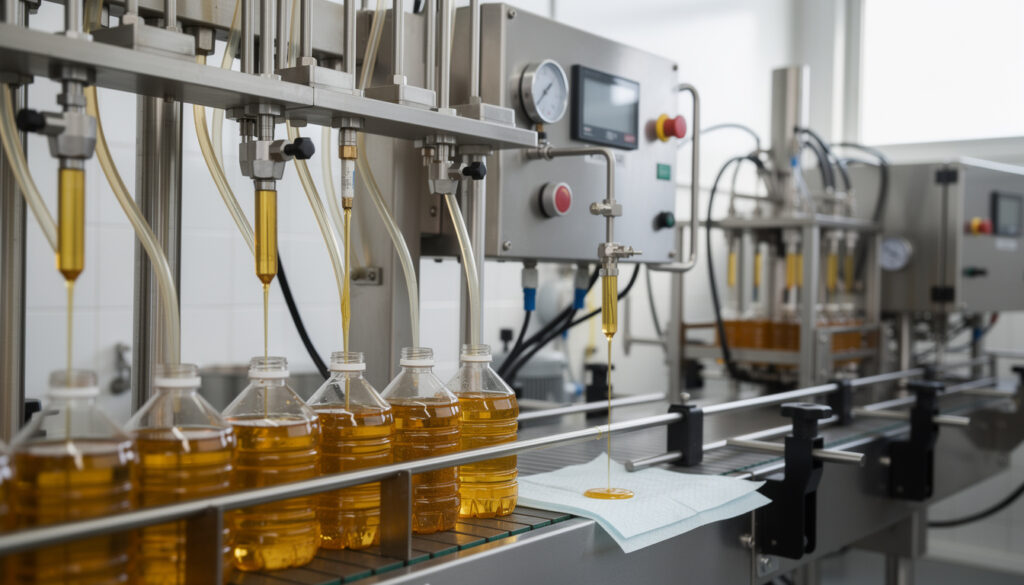

Filling machines are an integral part of the manufacturing and packaging industries, playing a crucial role in ensuring that products are accurately and efficiently filled into containers. These machines are used across various sectors, including food and beverage, pharmaceuticals, cosmetics, and chemicals. Among the different types of filling machines, those designed for handling industrial oils present unique challenges due to the viscous nature of the liquids involved. This article delves into the intricacies of industrial oil filling machines, exploring the challenges faced in handling viscous liquids and the innovative solutions that have been developed to address these issues.

Industrial Oil Filling Machines: Challenges in Handling Viscous Liquids
Industrial oil filling machines are specifically designed to handle the complexities associated with filling viscous liquids. Viscosity, a measure of a fluid’s resistance to flow, can significantly impact the filling process. High-viscosity oils, such as lubricants and greases, require specialized equipment to ensure accurate and efficient filling. One of the primary challenges in handling viscous liquids is maintaining a consistent flow rate. Unlike low-viscosity liquids, which flow easily, viscous oils can be difficult to pump and may require additional pressure or heat to facilitate movement.
Another challenge is the potential for air entrapment during the filling process. Viscous liquids are prone to trapping air bubbles, which can lead to inaccurate fill levels and compromised product quality. To address this, many industrial oil filling machines are equipped with degassing systems that remove air from the liquid before it is dispensed into containers.
Moreover, the abrasive nature of some industrial oils can cause wear and tear on machine components, leading to increased maintenance costs and downtime. To combat this, manufacturers have developed machines with durable materials and coatings that can withstand the harsh conditions associated with filling viscous oils.
Solutions for Efficiently Filling Viscous Liquids
To overcome the challenges associated with filling viscous liquids, manufacturers have developed a range of solutions that enhance the efficiency and accuracy of industrial oil filling machines. One such solution is the use of positive displacement pumps, which are capable of handling high-viscosity fluids with precision. These pumps work by trapping a fixed amount of liquid and forcing it through the system, ensuring consistent flow rates and accurate fill levels.
Another innovative solution is the implementation of heated filling systems. By applying heat to the liquid, its viscosity is reduced, allowing it to flow more easily through the machine. This not only improves the filling speed but also reduces the risk of air entrapment and ensures a more uniform fill.
Advanced control systems have also been integrated into modern filling machines to enhance their performance. These systems use sensors and software to monitor the filling process in real-time, making adjustments as needed to maintain optimal flow rates and fill levels. This level of automation not only improves efficiency but also reduces the likelihood of human error.
For more information on oil filling machines, visit https://stm-pack.com/machines-categories/filling-machines/oil-filling-machines/.
Future Trends in Industrial Oil Filling Technology
The future of industrial oil filling technology is poised for significant advancements as manufacturers continue to innovate and improve upon existing solutions. One emerging trend is the integration of IoT (Internet of Things) technology into filling machines. By connecting machines to the internet, manufacturers can collect and analyze data in real-time, allowing for predictive maintenance and improved operational efficiency.
Another trend is the development of more sustainable filling solutions. As environmental concerns continue to rise, manufacturers are exploring ways to reduce waste and energy consumption in the filling process. This includes the use of eco-friendly materials and the implementation of energy-efficient technologies.
Additionally, the demand for customizable filling solutions is increasing as manufacturers seek to cater to a diverse range of products and container sizes. This has led to the development of modular filling machines that can be easily adapted to meet specific production requirements.
In conclusion, industrial oil filling machines are essential for the efficient and accurate filling of viscous liquids. By addressing the challenges associated with viscosity and implementing innovative solutions, manufacturers can ensure the quality and consistency of their products. As technology continues to evolve, the future of industrial oil filling machines looks promising, with advancements that will further enhance their performance and sustainability.